
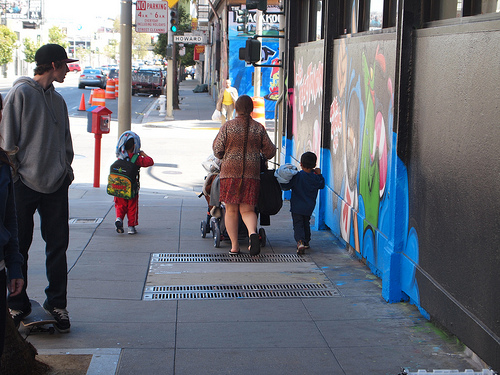
Childhood Homelessness

http://www.flickr.com/photos/elizaio/4916989324

photo credit: elizaIO via photopin cc

I came across an article the other day about the effects of homelessness on children.  The subject is part of a larger commentary on the effects of Adverse Childhood Experiences.  Recent studies indicate that not only do traumatic childhood events affect our mental health as adults, buy also our physical well being.  In fact “many official causes of death, like cancer, smoking, AIDs, heavy drinking, or diabetes” can be the result of that underlying trauma.  Homelessness is not only one of those stressors all on its own, but often the springboard for additional trauma: emotional, physical and sexual abuse; having an incarcerated relative; mother treated violently; mental illness within the family; parental divorce; substance use; and physical and emotional neglect.

The article made so many good points, I wanted to quote them all here for everyone to read, but I think the text is best read in author Perry Firth’s own words.  Here are the passages that jumped out at me, but please click through the link to the entire article.

“What Dr. Blodgett found won’t shock anyone involved with this work, or for that matter, anyone who intuitively understands the importance of stability in a child’s life. In his study of elementary children, homelessness was as equally powerful in predicting troubling mental and physical health outcomes as other traumas, such as child abuse.”

“the brain doesn’t care what the stressful event is; it only registers the event as stressful. That is why children who are experiencing homelessness in many cases have the same chronic health outcomes as a child who has experienced abuse or neglect.  If there was ever an argument for early intervention, it would be this.”

“Another way to look homelessness is not just to examine it from the standpoint of childhood, but to ask whether it can be an outcome of extreme stress during an adult’s youth. Questions assessing just that relationship between toxic stress in childhood and adult homelessness were added to the 2010 and 2011 BRFSS.  What was revealed is that those adults who had experienced higher levels of adverse childhood experiences are also those adults more likely to experience homelessness.  Adult homelessness can be the outcome of toxic stress in childhood.”

“But I would like to point out that every negative impact I have written about here is a preventable outcome. If we commit time and resources, there is no reason why any child or adult needs to go without shelter, mental health care, or in the case of stressed families, stabilizing parenting interventions. It all becomes a question of motivation and action. Yes, there is an uphill battle to fight. But that does not change the fact that childhood trauma is wrong, in all of its forms.”

via Firesteel / Blog / Children and Adversity: Childhood Homelessness Can Cast a Long Shadow. By Perry Firth, Graduate Student, Seattle University Community Counseling, and Project Assistant, Seattle University’s Project on Family Homelessness
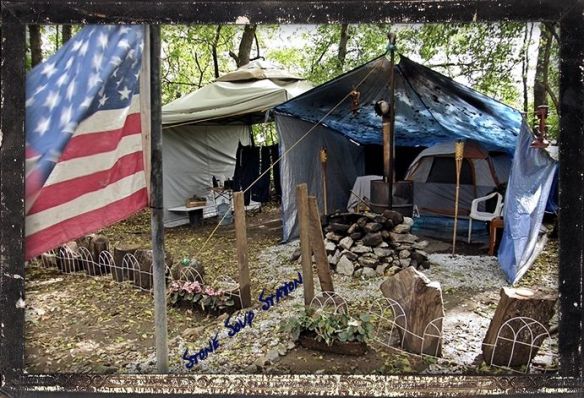
Stone Soup Station: Ego Creep

There is rarely, if ever, only one “truth.” One of my pet peeves is people who hold so tightly to their truth that they refuse to listen to anyone else’s.  I don’t know if it’s because they are secretly afraid their truth won’t hold up to the scrutiny, or if it’s because they have so little faith in themselves that they think they will be misled by “false prophets” if they even listen to a view different than their own. This is true in almost every aspect of life: religion and politics certainly, but also raising children, writing books, where to live, even simple things like the correct way to cook a certain dish.

I will admit to leaning toward the view of not trusting the police to deal fairly with the homeless.  Their job, after all, is to enforce the law and follow the rules and often the rules get broken when you live on the street, struggling to survive.  Too often it seems, there are officers who enforce with a capital FORCE, but I also don’t want throw law and order out the window. I have two sons who work in official security roles.  Like an anti-gay parent might rethink their views when confronted by a son or daughter coming out of the closet, I am forced to consider, rethink and possibly alter my views based on evidence.

So I am torn between wanting to support the brave men and women who serve in law enforcement and concern about the potential abuse of power that could exist. I don’t think that’s a bad place to be, though.  It prevents “ego creep” which would blind me to the fact that gray areas happen all the time and we must sometimes shift our vision to see clearly in the resulting gloom.  The article below talks about the difficulties of sifting through the gray areas and complexities of the “truth” about homelessness.  I hope you’ll click through and read the whole thing.

While the devotion to social justice is admirable, the ego-creep afflicted individual often ends up doing more harm than good.

Why? Because first of all, the needs and situations of the homeless are so complex and varied that no one person could possibly know and meet them all. This narrow kind of “I know what’s right” thinking is not only harmful to those they fail to serve because they’re almost certainly missing important needs, it is also dangerous for those experiencing homelessness because the ego-creeper is single-handedly fomenting and perpetuating an adversarial “us versus them” mentality among the homeless population and the rest of the community. There is enough of that already without them adding to the mix. No matter how much time any of us have spent working on the streets, none of us “know it all,” and we certainly cannot possibly know what the best approach or service need is for every single person out there. To assume so only highlights the affected individual’s ignorance of trauma informed, person-centered care, of the need and importance of cultural responsiveness, and illustrates a lack of professional capacity for serving the population we all profess to care so deeply about.

via Stone Soup Station: Ego Creep.