All In the Family

“Having mental illnesses doesn’t mean a person can’t be highly intelligent and extremely successful professionally”

via Coming Out Bipolar, Round 1 « Disorderly Chickadee.

Einstein

You probably know, if you’ve been following this blog, that the main character in my second Street Stories suspense novel, Bend Me, Shape Me, has a main character who is diagnosed as bi-polar.

What most people probably don’t know, is that my dad was bi-polar also.  This didn’t get diagnosed until later in life.  I was already married and out of the house by then, so not as aware of the toll this took on my mother and younger siblings.  Looking back, I guess I can see signs of it before then. He was quick-tempered sometimes and prone to bouts of extravagance, though quite frankly that seemed more like his passionate Italian heritage showing.  I never remember seeing him depressed as I was growing up, which I’ve always thought had to be present to qualify someone as a manic-depressive.  In fact, he was almost always over-the-top outgoing and had a great sense of humor.  Everyone who met my dad, I think, liked him instantly.

He was on medication for heart problems when the bi-polar red flag first waved its undeniable banner.  Sometimes I wonder if there was some combination of drugs that produced the illness, or at least maybe aggravated what had only been an “inclination” to bi-polarism.  There is a lot I don’t know about the subject, despite the research I did for the novel.  In fact, I believe there’s a lot doctors don’t know about the subject either.  Slapping labels on patients that don’t entirely fit seems to happen too often these days.  But that’s a whole other issue I don’t have time to talk about today.

My point today is that mental illness (whether correctly diagnosed or not) is a fact of life in many families today.  In fact, it may be that EVERY family has someone dealing with a disorder even if not everyone knows about it.  It may not be your immediate family, but I bet you have at least one relative somewhere down the line who has one of the 188 mental disorders defined by the DSM and ICD.   The Wikipedia list covers everything from Stuttering (stuttering?) to Schizophrenia, and includes commonly recognized conditions like ADD as well as a few that seem like an odd fit, such as Child Neglect.

If someone you loved found out they were sick, would you turn your back on them and walk away?  Would your fear turn to anger and disgust?  Would you cringe if they asked you for something and tell them to get a job? If you’re the kind of person who would not, I hope you will keep that in mind when you meet strangers suffering from an illness they didn’t ask for or do anything to deserve. Whether that person is homeless or a successful entrepreneur carefully monitored by a team of highly paid doctors, they are doing their best to deal with what life dealt them.

My dad didn’t have to deal with his disorder for long.  A few years later, his heart problems ended his life.  My mother spent that time treating him with a grace, love and understanding that is an inspiration to me.  I think maybe her positive example influenced my own desire to reach out and accept and love despite how difficult or scary or even ugly things can sometimes get. If more people were like her, the world would be an entirely different place.
Bylines and Babies: Those Were the Days

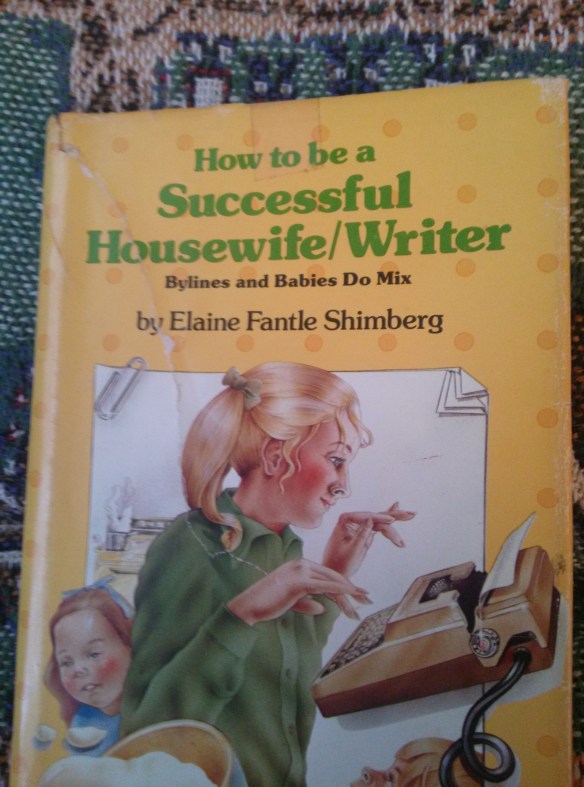
CAM00031When I found this 1979 copyrighted book among other yellow and dusty volumes in my storage unit, I fully expected to use it to make jokes about the Suzy Homemaker I used to be when I was young, married and the mother of two small boys.  In those days I was trying to live up to the expectations of my 50s-raised husband (and my own, I admit it).  Looking back I am sometimes appalled, because I see a woman completely different from who I am now and even unlike the mouthy hippy chick I was in my teens.  What alien took over my body during those thirteen years?

However, this outdated book actually is a testament to the burgeoning women’s movement of the seventies and eighties.  It is an example of women forging forward with being their own persons and offers suggestions for how to walk the tightrope to having it all if you really want it.

The chapter on housekeeping is an example of the mind-switch women were making.  It is not only about ways to make cleaning more efficient and quicker so you can keep the hubby happy.  It includes ways to add your personal needs to your list of priorities—and not at the bottom of the agenda, either.  Even the chapter title indicates the idea of a woman’s “choice” which would have been radical if written in the 50’s: How to Do Housework Faster — (OR NOT AT ALL). (CAPS added by me for reference.)

I found one section in the chapter particularly humorous: “If No One Notices It, Don’t Do It.”  That doesn’t mean letting the cat poop in the basement stay there until the smell goes away because it’s petrified. It means wait to clean up the cat poop until you’ve finished that last chapter. It means make a deal with your neighbor to do all the car pooling in exchange for free baked goods which you love to do anyway.

“Never buy anything that needs ironing.”  Use delivery services to save time, and make your kids do their part. Don’t shy away from take-out or convenience foods. Find creative activities that keep the kids happy yet out of your hair at the same time. The book is full of advice which would work even today, and is not limited to the housewife portion of the title.  There are helpful tips for the woman writer, too.

I did find a few things I could take issue with, but maybe it’s just me.  “If clutter annoys him, hide it.”  I say tell him to pick it up if he doesn’t like it, or wait till I get around to it. There’s a section in a chapter on Coping With Family that is “How to Keep Hubby Healthy and Happy.”  I like to think he’s responsible for his own happiness. Still, the book does also have many suggestions of ways to find compromises, which is important in a relationship.

I bought this book at an important time in my life, when I was trying to remember who I was and what I wanted out of life.  Looking at the contents now, I think maybe it was one of the first steps I took to becoming a serious professional writer.  It may even be one of the reasons I developed this audacity to try making my living through my craft.  For that, I thank the author, Elaine Fantle Shimberg.  Wherever she is now, she was way ahead of the game then.

This slideshow requires JavaScript.

Other (and considerably more current) works of the author can be found HERE.