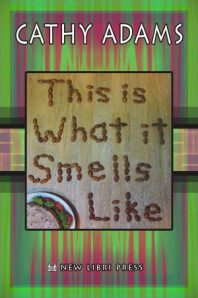
 Cathy Adams is a southerner who is a long way from home. Her novel, This Is What It Smells Like was published last year by New Libri Press, but she is also an award-winning writer with short stories and essays in her repertoire.
Cathy writes about how such a big change in her life is changing her writing voice as well, but I have to admit I am a little envious of Cathy’s adventurous life right now. I think we should all be encouraged to spread our wings and dare to explore the world a little more.
~~~~~~~~~~~~~~~~~~~~~~~~~~~~~~~~~~~~~~~~~~~~~~~~~~~~~~~~~
On Being a Southern Writer When You’re Not in the South
I’ve been a southern writer all my life. I was born in Alabama and have lived in Georgia and North Carolina. I’m still a southern writer who is no longer in the south. I’m not even in America. For the past seven months I’ve been living in China, on the opposite side of the planet from my southern heritage, and now I have to figure out what it means to be a southern (American) writer in China.
I wear my southern culture like a little birthday suit. It is that thing I understand the nuances of through sight, smell, touch, sound, and taste even if I can’t tell you what makes something southern. I know the taste and texture of a glass of tea the way we (meaning the great southern WE) drink it. I’ve tried to duplicate it with the ingredients I can get here in Xinzheng, but I can not make sugary, filled to the top with ice, sweet tea even in my own apartment the way I did back in North Carolina. The granulation of the sugar is not the same texture. The ice from the filtered machine does not taste the same. The tea is not the same brand or strength. It does not “set” properly the way tea did on humid afternoons in Alabama, leaving the sugar slightly syrupy against the flavor of the tea leaves. Even the color of the liquid is not the right orange/amber/brown. So, I keep settling my taste for the tea of “home” to the altered tea of China, which is, in truth, my home now, and when I sit down to write, the flavor is never quite the same either.
For me, home and voice are intertwined. Where you come from determines, in part, how you see the world, and how you see the world affects voice. I can’t speak for all southerners, but for me Southern culture has created a fiercely unapologetic spirit and a sometimes unforgiving nature. We’re all responsible for ourselves but at the same time we’re all obligated to help one another along and at the very least not put obstacles in the way of others. The latter ideals have served me fairly well, the former has been a burden I willfully try to shake off but never quite lose. I see those worldviews when they come into my writing; if they’re not being funneled directly into my characters they still affect my language choices. I can change my voice to some extent, depending on the character, but that “fingerprint” of my voice always manages to come through, even if only a little bit.
Bringing my southern writing voice to China means it’s going through changes, and I can’t help but wonder, if I spend enough time here in central China will it be altered to the point that I will no longer sound like a southern writer? (Is there even a place in the literary world for hybrid Alabama/Xinzheng writers?) The discomfort seems to lie in the fact that before I came to China I was rather settled into my voice. Over the past few years we’d become familiar chums; it was recognizable, predictable. Now all this growth and change leaves me increasingly uncertain in my writing style. The smart, confident part of me thinks I should jump in and embrace it, run with it to see where it takes me. The fearful part of me thinks I have to sit down and pull it apart to figure it out before I can continue writing. It’s clear which one I should be listening to.
~~~~~~~~~~~~~~~~~~~~~~~~~~~~~~~~~~~~~~~~~~~~~~~~~~~~~~~~~~~~
AUTHOR BIO
 Cathy Adams’ short stories and essays have been published in Utne, The Philosophical Mother, Ghoti Magazine, Heliotrope, and WNCWoman, among others.
Her writing awards include the Mona Schreiber Award for Fiction, a National League of Pen Women’s Prize, and a National Public Radio News Director’s award. Her work has been aired on Georgia Peachstate and Isothermal Public Radio networks.
She lives in Asheville, North Carolina, and is busy at work on her next novel. Cathy is a wine and chocolate connoisseur and has dabbled in designing her own clothes.
You can visit Cathy’s Tumblr bog here.
This Is What It Smells Like can be purchased at Amazon or Barnes and Noble, or ordered from your local bookstore.


 Debra R. Borys