Unknown's avatar

About dborys

Author of STREET STORIES suspense novels

Ode to the Typewriter

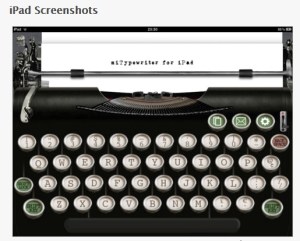
Two things brought nostalgic thoughts of typewriters to my mind recently.  The first was a friend’s post on Facebook about an iPad app that mimics the appearance and sound of a typewriter, and the second was the article below about a library system’s last remaning typewriter.  I wonder if it says something about the worth of a typewriter that access to the one they have left is kept under supervised lock and key.  Or maybe it just says something about the state of humanity that people can’t be trusted.

My last typewriter was a Smith and Corona electric.  Not as fancy as the one in the article below which has a memory cache, but a trusty friend nevertheless.  Unfortunately, my husband got custody of Smith during the divorce.  I had to waive my rights in return for custody of my IBM PC Junior.  Even that far back it was clear the future belonged to computers.  I suspect that instead of being engaged for a useful purpose, the machine ended up on top of a sacrificial bonfire scourging all evidence left behind which proved I once existed.

Whatever happened to it, I hope its last days were filled with fond memories of reams and reams of paper rolled beneath its platen, and the loving hammer of fingers tapping out the first novel I ever wrote as an adult.  I hope it bore the scars of paper dust and carbon smudges proudly.

The typewriter by many is mourned
With keys and platen well worn
Its clickity clack
The return handle zap
Will be heard by writers no more

The metallic clatter the Satellite 40’s daisy wheel makes when it strikes the platen definitely seems too loud for a library, and even too loud for a high-tech informational retrieval center, but it sure is satisfying. If your thoughts come slowly but steadily, the Satellite 40 lends a sense of craftsmanship to your work, as if you’re building arguments as sturdy and elegant as a redwood deck. If inspiration strikes and your thoughts come more quickly, the Satellite 40 explodes with the sound of your mental firework

via In a Library, San Francisco’s Last Public Typewriter – NYTimes.com.

Prostitution? Or Sex Trafficking?

My first Street Stories suspense novel, Painted Black, tells the tale of Lexie Green who chose prostitution as a way to both survive and escape her reality. The meager funds her pimp allows her provide fundamental food and shelter but are also used to purchase heroin so she can zone out emotionally from a life that has grown too hard to bear.

The next book in the series, Bend Me, Shape Me, which I am currently working on features a young woman who is half Native American.  She has been torn from that heritage and is haunted by a past that includes an alcoholic mother too drunk to raise her children in a nurturing environment.  Because of that past, Snow Ramirez disdains her roots which leads to a self hatred that overshadows her behavior.

The story linked below struck me as meaningful to both of these street stories.  It talks about the blurring lines between sex trafficking (kidnapping, enslavement) and a supposed voluntary choice to sell your body to anyone willing to pay.  Did Lexie really have a choice when her mother kicked her out at twelve years old?  Can a scared, lonely adolescent really choose to leave a pimp who alternately charms and then uses her?

Likewise the article discusses how the sex trade is heavily targeted toward minorities.  In the cases cited, they specifically address how Native American women suffer “sexual subjugation as a product of European and American colonization—warfare, slavery and relocation all played significant roles in the destruction of Indian nations and the subsequent commercialization of Native women’s bodies.”

Photo courtesy of
DavidDennisPhotos.com

The article talks a lot about statistics and the dangers of prostitution in general.  But most heartbreaking of all, to me, is the article’s description of a mother risking her life to call attention to the “enslavement” of her daughter.  Despite being warned to keep silent by the girl’s pimp, Mary speaks up because, to her, her daughter “is still the little girl who couldn’t sleep without her hands entwined in Mary’s long black hair.”

That kid you see on the street corner—whether male and female—was once a toddler reaching for a parent’s hand and longing for a parent’s love.  Maybe if someone offers them a hand of friendship now, they can recover some of the innocent hope they had then.

Farley believes that the attempt to separate the two is illogical, creating a false distinction between innocent victims of trafficking from those who choose prostitution. Farley points out that no such line exists, since most prostitutes enter that life between the ages of 12 and 14, far too young to make such a momentous decision. Prostitution and trafficking are expressions of sexual violence. The vast majority of individuals being bought and sold for sex must answer to a pimp figure who not only benefits from their sexual exploitation, but also dictates every aspect of their lives,

via Native Girls Are Being Exploited and Destroyed at an Alarming Rate – ICTMN.com.